Check out our current Offers: Check Now
AC Repair in Roswell, GA
AC Repair in Roswell, GA | One Hour Heating & Air
One Hour Heating & Air Conditioning of North Atlanta handles the full range of AC repair for Roswell homeowners, from quick fixes that finish in 45 minutes to complicated diagnostics in older homes where the problem isn’t where it looks. We hold Georgia HVAC license GAREGCN2011384 and dispatch 24/7 from our Alpharetta office, a short drive from historic Roswell, Holcomb Bridge, Martin’s Landing, and the Vickery Creek area. Our EPA 608 certified, NATE certified technicians are factory authorized on Daikin, Trane, Rheem, and Carrier. Whatever brand is in your home, whatever the system’s age, we have the parts on the truck for most repairs and the diagnostic experience to find the real problem when the obvious answer isn’t the right one.
Always On Time...Or You Don’t Pay A Dime!® If we’re late, you don’t pay the diagnostic fee. Backed by our 100% Satisfaction Guarantee for two years.

4.81
Google Reviews
Book Your Same-Day Visit
Need AC Repair service today?
Georgia HVAC license GAREGCN2011384
EPA 608 certification PFWXHNZ4MT
NATE certification 1023518
Daikin
Trane
Rheem
Carrier
What We Repair on Residential AC Systems
A residential AC system has dozens of components that can fail, and the symptom a homeowner notices rarely points cleanly at the actual cause. Here’s the range of repairs we handle on Roswell calls:
Refrigerant problems. Low refrigerant from a leak, overcharge from a bad prior service, the wrong refrigerant in the system. We find the leak first, repair or replace the affected component, then recharge to the manufacturer’s spec on the unit itself, not by guess.
Frozen indoor coils. A coil that ices up usually means either low refrigerant, restricted airflow from a dirty filter or blocked return, or a stuck blower. We thaw the system, find the underlying cause, and fix the cause so it doesn’t freeze again next week.
Compressor problems. Hard start failures, compressor cycling, complete compressor failure. Sometimes a hard start kit is the fix. Sometimes the compressor is replaceable. Sometimes the system is old enough that replacement of the whole unit makes more sense than rebuilding the compressor.
Electrical component failures. Capacitors, contactors, relays, fan motors, and control boards. These are some of the most common AC repairs in any home, and we carry replacement parts on the truck for the brands we service most often in Milton.
Refrigerant leaks. Indoor coil leaks, outdoor coil leaks, line set leaks, valve leaks. We use proper leak detection equipment, not guesswork. Once the leak is found, we repair or replace the affected part and recharge.
Drainage and condensate issues. Clogged drain lines, failed condensate pumps, tripped float switches, drain pan damage. Heavy pollen in spring and humid conditions in summer make drainage problems a regular Roswell call.
Airflow problems. Bad blower motors, failed blower wheels, dirty evaporator coils, restricted ductwork, return air problems. The symptom usually shows up as poor cooling, but the cause is in the airflow path.
Thermostat and control problems. Failed thermostats, miswired thermostats, smart thermostat compatibility issues, zone control board failures. A surprising number of “broken AC” calls turn out to be thermostat or wiring problems.
Sensors and safety switches. Pressure switches, high limit switches, freeze sensors, condensate float switches. These shut the system down when something else is wrong, and the fix usually involves diagnosing what triggered the safety, not just bypassing it.
Outdoor unit problems. Failed condenser fan motors, bent fins, damaged contactors, electrical issues at the disconnect. We diagnose at both the indoor and outdoor units because the problem can be at either end.
Ductwork issues. Disconnected ducts, crushed flex runs, leaky joints, undersized returns. In older Roswell homes this is a major category, and we’ll show you what we find when the duct system is part of the problem.
If something is wrong with your AC and it’s not on this list, it’s probably some combination of these. The diagnostic is the same: figure out what the system is actually doing versus what it should be doing, find the gap, and fix the cause.
How We Diagnose AC Problems
The diagnostic process is the same on every call regardless of brand, age, or system type:
1. Listen to what the homeowner describes happening. The story is often more useful than the symptom.
2. Check the thermostat and zone controls. In Milton homes with multiple zones, this means checking each zone’s call and the boards directing them.
3. Check airflow at the equipment and at the rooms. Restricted airflow hides equipment problems, especially in older Roswell homes with original ductwork.
4. Check refrigerant pressures against the manufacturer’s spec on the unit nameplate, not against a generic chart.
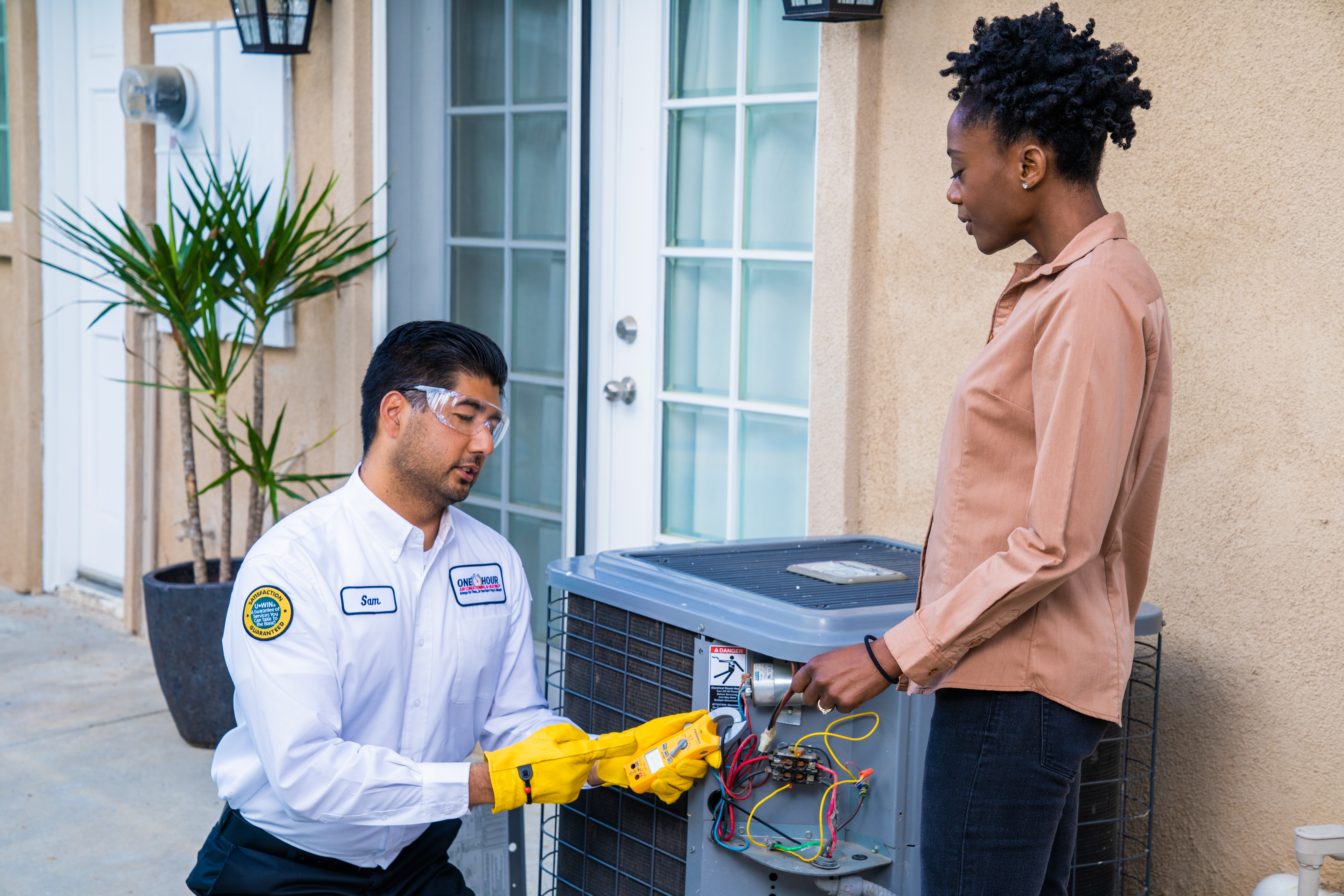
5. Check electrical components with a meter. Capacitors get tested against their rated value, not eyeballed.
6. Check the outdoor unit, the indoor unit, and the connections between them.
7. Walk through findings with the homeowner before any repair work starts.
8. Provide a written estimate. The homeowner approves or declines before any parts come off the truck.
The $89 service call covers the visit, the full diagnostic, and the written estimate. If you approve the repair, the $89 is applied to the repair cost.
AC Repair in Roswell, What’s Specific to This City
Beyond the general range of AC failures, Roswell’s housing pattern creates specific repair scenarios that come up more often here than elsewhere.
Roswell’s housing falls into three groups, and each one creates a different kind of AC repair call. The historic district off Canton Street has homes that predate 1900 in some cases, retrofitted for central air decades after they were built. The bulk of Roswell, neighborhoods like Martin’s Landing, Brookfield West, and Sweet Apple, went up between the 1960s and 1980s. Then there’s newer infill scattered across the city. The three groups need three different conversations about what’s wrong and what to do about it.
The 1960s to 1980s majority is where most of our Roswell AC repair work happens. These homes are now on their second or third AC system, but the ductwork in the attic is usually still original. Attic ductwork in this part of Roswell commonly leaks 20 to 30% of the cooled air before it ever reaches the rooms. That means a system that’s technically working fine on the gauges still leaves the house warm, runs longer than it should, and burns out parts faster than it would in a tighter house. When a Sweet Apple or Brookfield West homeowner calls because the system can’t keep up, the fix isn’t always at the unit. Sometimes it’s at the ducts.
The historic district homes off Canton Street present a different problem. Original construction didn’t account for central air, so the AC systems are retrofits, often squeezed into spaces that weren’t built for them. Refrigerant lines run unusual routes. Drain lines drop through walls that were finished a hundred years ago. When something fails in one of these homes, the diagnosis is straightforward, but the repair sometimes takes longer because the equipment isn’t sitting where modern HVAC equipment expects to sit.
Basement installed furnaces are common across Roswell’s older stock, which matters for AC repair because the indoor coil sits on top of the furnace. When the indoor coil leaks refrigerant in a basement installation, the work happens in a tight space with limited clearance, which we plan for before we arrive.
Permits in Roswell run through the City of Roswell Community Development department. Straight repairs don’t need permits. Full system replacements, refrigerant work, and electrical changes do, and we handle that paperwork as part of the job.
Problems We See More Often in Roswell Homes
These show up on more Roswell calls than they do in other parts of our service area:
The system runs fine but the house won’t cool. The AC at the outdoor unit is working. The blower at the indoor unit is moving air. But the cooled air loses 20 to 30% of its punch through leaky attic ductwork before it reaches the rooms. The fix is sealing the ducts, not replacing the AC.
Worn out electrical components on 20 plus year old systems. Roswell homes on their second AC, where the second system itself is now 15 to 25 years old, run into capacitor and contactor failures regularly. These are replaceable parts that fix the immediate problem, but on a system that age, we’ll also tell you what else is likely coming so you can plan ahead rather than get caught off guard.
Refrigerant leaks on indoor coils in basement installations. Coils corrode over time, especially in basements that get humid in summer. When we find a leak on a basement installed system older than 12 years, the repair conversation includes a replacement conversation, because the labor to access and replace just the coil is significant on basement installs, and the math sometimes favors a full replacement.
Retrofitted AC in historic homes losing capacity. Homes near Canton Street that had central AC added in the 1980s or 1990s sometimes had systems sized for the era and the budget, not the house. When those systems fail, the right question isn’t always how to fix what’s there. Sometimes it’s whether a properly sized replacement, possibly a heat pump, makes more sense for the way the house actually loses and gains heat.
What to Expect on the Day
A typical Roswell AC repair call runs about an hour to an hour and a half from arrival to finish. Historic district calls sometimes run longer because of access. We text on the way with a photo of your technician. The diagnostic takes about 20 minutes, plus extra time if we need to check ducts in the attic or access equipment in a basement. If parts are on the truck, the repair starts right after you approve the written estimate. If a part isn’t on the truck, we tell you the timeline before we leave, and most parts are available same day or next morning from local supply.
You don’t need to do anything before we arrive. If your AC has shut down completely, leaving the thermostat off is fine. If the system is running but not cooling, leaving it running helps us see what’s actually happening.
Cost Considerations for Roswell Homeowners
The $89 service call and diagnostic is waived when you proceed with the repair, and it’s free for Comfort Club members.
Most Roswell AC repairs land in the $228 to $1,500 range. Electrical component swaps are at the low end. Drain pump replacements, indoor coil repairs on accessible systems, and blower motor work land in the middle. Indoor coil replacements on basement installations, where the coil itself isn’t the costly part but the labor is, push toward the high end. The full range for AC repair runs $228 to $3,000+ depending on what failed.
Two things specific to Roswell affect cost. First, the older the home, the more likely the repair runs into something the original installer did that doesn’t match current standards. We document what we find before we touch it. Second, ductwork problems often surface during AC repair calls in Roswell, and while we won’t tack on work you didn’t ask for, we’ll show you the airflow numbers if your ducts are clearly part of the problem. Sealing leaky ductwork qualifies for Georgia Power’s HEIP home comfort bundle rebate of up to $1,250, which sometimes changes the math on whether to invest in the existing system.
When the repair bill crosses roughly 50% of what a new system would cost on a system older than 12 years, we lay out the math both ways before you decide. Replacement runs $2,500 to $8,000+ for AC alone, with financing as low as $109/month. A complete HVAC system, AC plus furnace or full heat pump conversion, runs $7,000 to $25,000+ on Roswell homes. Older homes with leaky ductwork sometimes need the duct work addressed as part of a replacement, which pushes those projects toward the higher end of the range but also addresses the underlying problem that was wearing out the old equipment.
Comfort Club at $177/year includes an annual AC tune up, an annual furnace tune up, priority scheduling during peak season, and 15% off any repair. For Roswell homeowners with older systems where small problems compound quickly, the annual tune up catches a lot before it becomes a hot afternoon emergency.
Need AC Repair service in Roswell
24/7 dispatch. Upfront flat rate pricing. "Always On Time...Or You Don't Pay A Dime!"
Recent Work Near Roswell
Martin’s Landing, 1978 build, original ductwork still in place after two AC replacements over the decades, homeowner called because the upstairs wouldn’t cool below 78° in July, diagnostic showed the AC was performing within spec at the unit, attic duct inspection revealed multiple disconnected and crushed runs leaking heavily, repair was duct sealing and reconnection rather than equipment replacement.
Historic district off Canton Street, 1920s home with retrofitted 2008 system, indoor coil refrigerant leak in tight basement closet installation, accessed and repaired over a long single visit, owner planning replacement in two seasons and we provided sizing options.
Sweet Apple, 1995 build on second AC system from 2007, capacitor failure on a 96° August afternoon, replaced on the truck, system back online same day, recommended Comfort Club membership for priority service going forward.
Neighborhoods in Roswell
Martin’s Landing. Built in the 1970s, large traditional homes with attic ductwork that’s now 50 years old. Duct leaks frequently surface as AC capacity problems.
Brookfield West and Sweet Apple. Heavy 1980s and 1990s construction, homes now on their second AC system. Replacement electrical parts and indoor coil work make up most of our calls here.
Historic district and Canton Street area. Retrofitted central air in homes that predate 1900 in some cases. Diagnosis is the same but access and equipment placement create unique repair scenarios.
Gallery and Video

FAQs About AC Repair in Roswell
My Roswell home was built in 1975 and the AC has been replaced twice. Why does the upstairs still not cool?
Almost always the ductwork. Original 1970s ductwork in Roswell attics commonly leaks 20 to 30% of the cooled air before it reaches the rooms. New AC systems get installed without anyone checking the ducts, and the new system inherits the same problem the old system had. The fix is sealing the ducts, which addresses the underlying issue rather than masking it.
Do I need a permit to repair my AC in Roswell?
Repairs to existing equipment don’t need a permit. Full system replacements, refrigerant work, and electrical changes do require permits through the City of Roswell Community Development department. We handle that paperwork when the job calls for it.
My historic district home was retrofitted for central air decades ago. Is replacement complicated?
Sometimes. The original construction didn’t plan for HVAC equipment, so retrofits often used whatever space was available. When the time comes for replacement, we look at what’s there, what the house actually needs, and whether the original retrofit decisions still make sense or whether a different approach, sometimes a heat pump, fits the house better.
My AC keeps freezing up. What’s causing it?
A frozen indoor coil almost always means one of three things: low refrigerant from a leak, restricted airflow from a dirty filter or blocked return, or a stuck blower motor. We thaw the system, find the underlying cause, and fix the cause. Just refilling the refrigerant without finding the leak means you’ll be calling us back in a month.
My Milton home was built in 2002 and has four AC systems. Should I replace them all at once or one at a time?
The coil itself isn’t the costly part. The labor to access and replace it in a tight basement closet is, because we have to work in the space that exists, not the space we’d design. On a system older than 12 years, we’ll usually walk you through both the coil repair cost and a full replacement cost so you can make the call.
Can I get a rebate for duct sealing if I do it during an AC repair?
Georgia Power’s Home Energy Improvement Program offers up to $1,250 in rebates for home comfort bundles that include duct sealing, insulation, and air sealing. The rebate doesn’t change the cost of the AC repair itself, but if you’re already doing duct work, the bundle can offset a meaningful portion of the project cost.
My AC uses R-22 refrigerant. Should I just replace it?
Usually yes. R-22 was phased out in 2020 and the remaining supply is expensive and shrinking. Repairs that require recharging an R-22 system often cost enough that replacement with a modern R-410A or R-454B system makes more sense, especially on systems that are already old enough to need R-22 in the first place.
Contact and Directions
1360 Union Hill Rd #5F, Alpharetta, GA 30004
Phone: (404) 689-4168
Hours: 24/7 emergency service. Standard appointment hours
Georgia HVAC License: GAREGCN2011384
Fully insured and bonded.
We’re located off Union Hill Rd in Alpharetta, a short drive from historic Roswell, Holcomb Bridge, Martin’s Landing, and the Vickery Creek area.

404-480-4941
1360 Union Hill Rd. STE 5F
Alpharetta, GA. 30004


COMPANY
AIR CONDITIONING
HEATING
Copyright 2026. One Hour Heating & Air Conditioning North Atlanta. All Rights Reserved.